

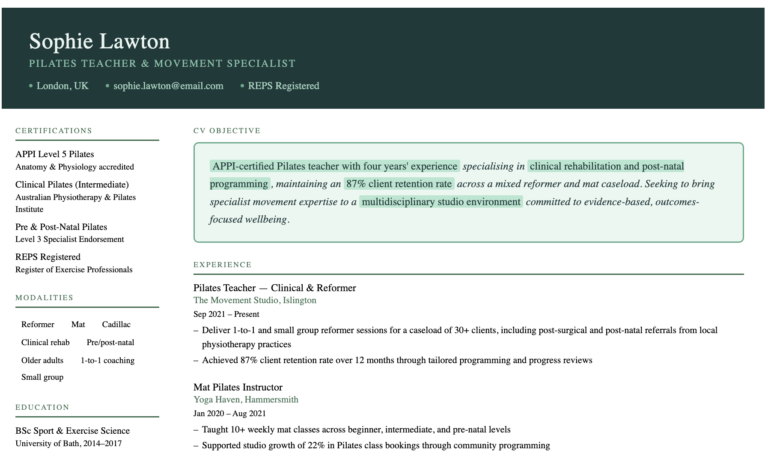
How to Write a CV Objective for Pilates Teachers
Standing out as a Pilates teacher in a competitive wellness market starts well before your first client interaction. A sharp,...
Read the Article

Getting your CV to stand out in the competitive fitness industry can feel daunting, but a well-crafted CV objective is one of the most effective ways to capture a hiring manager’s attention. Whether you’re applying to a gym, a boutique studio, or pitching yourself as a freelance PT, a strong opening statement can be the difference between landing an interview and being overlooked.
In this article, we discuss how to write a CV objective for a personal trainer role and share practical tips to help you take the next step in your fitness career.
A CV objective is a short statement that sits at the top of your CV. It summarises your relevant qualifications, skills, experience, and career goals, specifically within personal training and fitness coaching.
Think of it as your 30-second pitch in written form: a concise opportunity to show a prospective employer or client why you’re the right fit before they’ve read a single bullet point.
For personal trainers, a strong CV objective also signals your coaching philosophy, your specialism (whether that’s weight loss, strength and conditioning, rehabilitation, or group fitness), and the kind of impact you aim to have on clients.
Before writing a single word, read the job description carefully. A gym hiring a PT for its general floor will prioritise different qualities than a specialist studio looking for a pre- and post-natal coach or a sports performance facility seeking a strength coach. Identify the key skills, certifications, and values the employer is looking for and use these as the foundation of your objective.
Personal training is a regulated profession, so your certifications matter. Mention your level of qualification — such as a Level 3 Personal Trainer certificate or above — and any specialist endorsements upfront. If you’re currently working towards an advanced qualification or a specialist course, this is worth including too. newsite.create.fit/ offers a range of industry-recognised PT courses and specialist modules that can significantly strengthen your credentials and, by extension, your CV objective.
Once you’ve established your qualifications, use your objective to signal your niche. Whether you specialise in functional fitness, nutrition coaching, athlete conditioning, or working with older adults, naming your specialism immediately tells the employer whether you’re likely to be a good match.
If you have notable experience, such as working with a professional sports team, running a successful online coaching business, or achieving a strong client retention rate, mention it here.
Your CV objective should connect your ambitions with the opportunity in front of you. Avoid vague statements like looking for a rewarding role in fitness.
Instead, articulate what you want to contribute: for example, helping a gym grow its member retention through results-driven one-to-one coaching, or bringing specialist expertise in movement rehabilitation to a multidisciplinary wellness team.
Aim for two to three sentences. Your CV objective should hook the reader and encourage them to keep reading — not summarise your entire career history. Save the details for your experience and achievements sections.
No two gyms, studios, or fitness businesses are identical. A chain gym values consistency and volume; a boutique studio might prioritise personality and community fit. Research each employer before you apply and adjust your CV objective to reflect their culture and client base. This extra effort is consistently one of the most effective ways to make your application stand out.
Steer clear of generic phrases that could apply to any candidate, such as passionate about fitness or dedicated team player. Every personal trainer applying for the same role will use similar language — your objective needs to be specific to you. Avoid stating obvious facts (seeking a personal training position) and resist the temptation to list every qualification you hold; save that for the body of your CV.
You should revisit your CV objective whenever you gain a new qualification, complete a specialist course, or reach a meaningful milestone with a client. As the fitness industry evolves, with growing demand for online coaching, hybrid training models, and wellness-integrated services, keeping your objective current ensures you’re positioning yourself for where the market is heading, not where it’s been. A useful rule of thumb is to review your CV every six months, regardless of whether you’re actively job hunting.
If you’re looking to add new qualifications that genuinely strengthen your CV, Create’s personal trainer courses are worth exploring — particularly their specialist pathways, which can differentiate you in a crowded market.
A CV objective focuses on what you’re looking to achieve in the role you’re applying for — it’s forward-looking.
A personal statement, by contrast, summarises your background, experience, and what you bring to the table right now. Both appear near the top of your CV and serve to give the hiring manager a quick snapshot of who you are, but from different angles.
For newly qualified PTs, a CV objective can be particularly effective as it shifts focus from limited experience to clear intent and direction.
The most effective way to differentiate your CV objective is to include a quantifiable achievement.
Rather than an “experienced personal trainer with a track record of client success“, try something like:
“Level 3 PT with four years’ experience, specialising in weight management, with a 90% client retention rate over 12 months.”
Specific numbers are far more persuasive than adjectives. Combine this with confident, active language and any relevant specialist credentials — particularly those from recognised providers like Create — and your objective will immediately carry more weight.
Not every personal trainer role will explicitly ask for a CV objective, but including one is almost always worth doing. It frames the rest of your CV, gives the hiring manager an immediate sense of your value, and demonstrates that you’ve thought carefully about the role rather than sending a generic application.
For senior coaching positions, a more detailed professional summary may be more appropriate, allowing you to speak more fully to your expertise and career trajectory.
Standing out as a Pilates teacher in a competitive wellness market starts well before your first client interaction. A sharp,...
Read the ArticleFor more information on our content creation process, view our Editorial Policy. Key Takeaways Personal trainer course prices in the UK show huge...
Read the Article
For more information on our content creation process, view our Editorial Policy. Key Takeaways About 38% of people in England are now...
Read the Article